
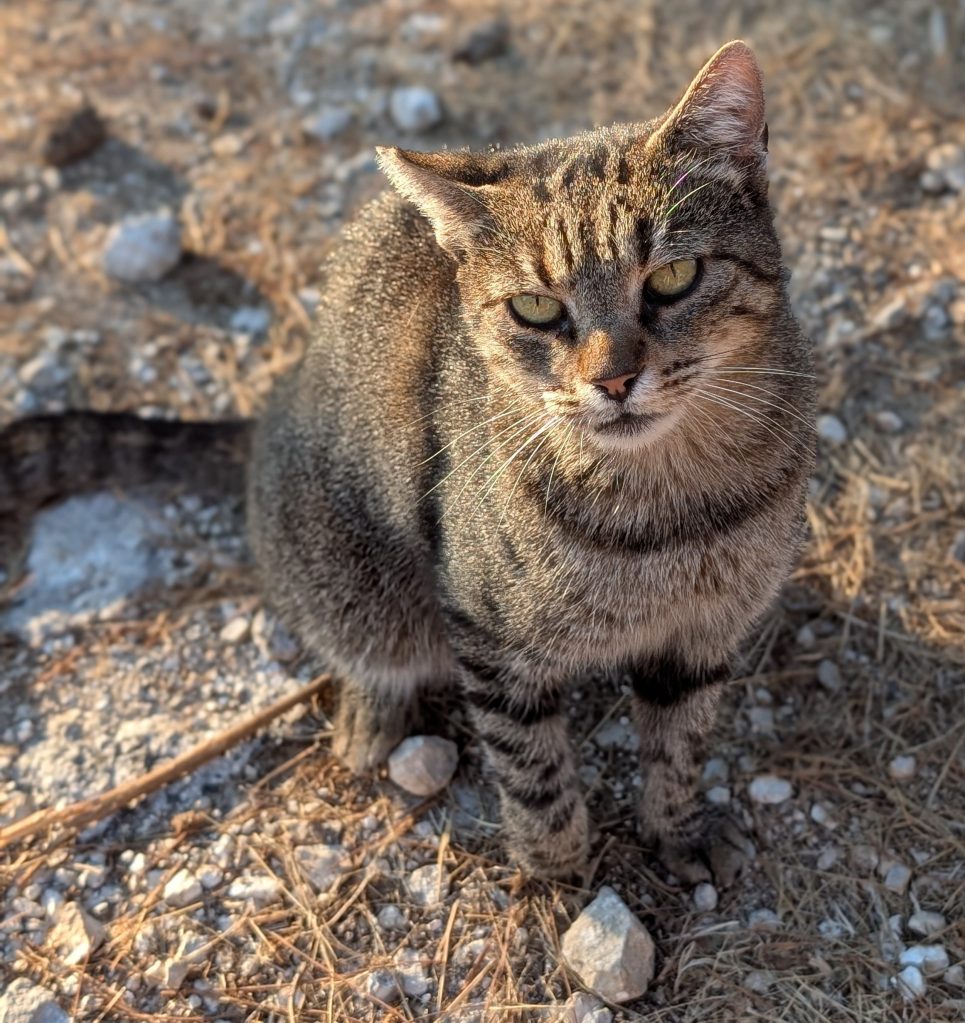
When I first met Biscuits, a sweet and affectionate stray cat living on the Greek island of Kefalonia, I never imagined that trying to find her a loving home would become such a complicated and emotionally exhausting experience.
What started with the best intentions turned into weeks of unexpected obstacles, difficult decisions, differing opinions and responsibilities I hadn’t anticipated.
I have enormous respect for those who dedicate their lives to helping stray animals, often with very limited resources. But I wanted to share my experience because it highlights just how complicated animal rescue can become, even when everyone has good intentions.
It All Started With an Instagram Video
I met Biscuits while holidaying in Kefalonia and immediately fell in love with her. I nicknamed her Biscuits because she would knead the ground whenever she saw me, which was simultaneously adorable and heartbreaking.
She was incredibly affectionate, happily accepting pets and jumping up to meet my hand. I visited her every day for a week, bringing her wet food from the local supermarket that she would eat ravenously.
Nevertheless, she seemed in surprisingly good health for a stray cat. She wasn’t skinny and her fur was soft.
Although I was told that local people regularly fed the colony, I couldn’t stop thinking about the dangers she faced living outdoors. Although she’d clearly survived so far (we later found out she was apparently 3 – 6 years old), I worried about how she might cope outdoors as she got older. She spent most of her time by a road and relied on the goodness of the locals, like the thousands of other stray cats in Kefalonia. I couldn’t help them all, but I could at least try and help one.
With three cats already at home, adopting her myself wasn’t realistic (two of my cats do not take well to new cats), so I decide to share a video with my Instagram audience in the hope of finding her a loving home.
I’d already spoken with a local charity experienced in handling international adoptions who had many success stories on their website. They explained that finding homes for stray cats on the island was extremely rare. They estimated that bringing Biscuits to the UK would cost around €1,400, which I hoped to cover through fundraising and my own contributions.
I assumed that if I could find an adopter and raise the money, the charity could help coordinate everything else.
Simple, right?
Unfortunately, not quite!
Finding a Home Abroad Was the Easy Part
Thanks to the wonderful Instagram cat community, just after I’d returned home I was connected with a lovely lady in the UK who wanted to adopt Biscuits. She was kind, enthusiastic and committed to giving her a loving home. Biscuits would have a secure cat-proofed garden to play in and 2 humans who were home most of the time to dote on her. It seemed perfect.
Other people also generously offered financial and practical support.
Everything seemed to be falling into place.
However, when I contacted the charity again, I discovered that they didn’t have anyone available to foster Biscuits. Stray cats need to be fostered for at least 21 days after receiving their rabies vaccine and microchip before they can travel abroad.
This was our first major obstacle, and suddenly we found ourselves trying to organise much of the rescue ourselves.
We needed someone to capture Biscuits, somewhere for her to stay, veterinary arrangements, travel documentation and international transport.
The charity was understandably stretched and I don’t blame them at all – they had limited volunteers and they all volunteered for free alongside their normal jobs – but it meant that much of the responsibility unexpectedly fell to us.
One Obstacle After Another
Finding a foster home proved particularly difficult, but it wasn’t our only problem.
We learned that the state vet responsible for issuing the necessary travel health certificate had apparently lost his contract, with no indication of when it would be renewed.
I began researching whether Biscuits could travel to Athens to obtain the certificate from another authorised vet, adding further complications.
Some people also suggested potential legal loopholes, but myself and others were uncomfortable with anything that might risk Biscuits being quarantined or encountering problems at the UK border.
Then there was the journey itself. I’d initially imagined Biscuits might be able to fly in the cabin with her adopter or me, but instead we were looking at a three-day van journey to the UK. This raised concerns amongst some people involved.
Unfortunately we found out that relocating animals from Europe to the UK has become increasingly difficult and complicated after Brexit. I would receive conflicting information and advice from various sources, which made it hard to know what to do.
What made everything particularly stressful was that it increasingly felt like I was having to research and navigate all of this largely myself, despite having no experience with international animal rescue or regulations and trying to deal with this all 1000 miles away from Kefalonia.
At times, I spent up to seven hours a day communicating with people, researching and trying to coordinate everything. I have a full-time job and other responsibilities so this was becoming increasingly difficult for me to manage.
I found myself acting as the central point of contact between people who often had different expectations and weren’t always in agreement about how things should proceed.
Whenever one obstacle seemed resolved, another appeared.
Help would often be promised then not materialise.
What I’d imagined would be a relatively straightforward adoption had become an overwhelming logistical challenge.
Different Opinions and Difficult Communication
Another unexpected complication was discovering that not everyone involved shared the same views about rehoming adult stray cats – perhaps partly due to cultural differences – which had led to existing tensions amongst some volunteers on the island.
Some felt that cats established in colonies should remain in their familiar surroundings, while others believed friendly strays like Biscuits could thrive in loving homes.
I believe both perspectives deserve consideration and that decisions should ultimately depend on the individual cat’s welfare.
But I think it is also important to recognise that it is very difficult to judge how well a cat will adapt to living in a calm peaceful home environment from how they behave outdoors in a stressful colony environment surrounded by many other cats. It is concerning if adult cats are not being given the chance of living safely indoors because of assumptions they won’t adapt.
There were also concerns and disagreements on aspects of the rescue process, for example how cats should be fostered. We found out that a lot of foster homes (although none were currently available) essentially involved being in a cage for 21 days, which some of us found troubling but others thought it was worth it for the cat to have a better life at the end of it all. But with minimal details available and no idea how Biscuits would react to such a change in environment, I began feeling a sense of anxiety over whether this was the right thing to do for Biscuits after all.
Unfortunately, communication between some of the people involved became increasingly difficult.
There were also difficulties and misunderstandings due to the language barriers.
Occasionally, conversations became more emotionally charged than I had expected, and some exchanges left me feeling rather upset.
I understand that animal rescue can be stressful and that people who care deeply about animals may have strong feelings about how things should be done.
But I found myself feeling increasingly out of my depth.
At times, it seemed that navigating the different perspectives involved was the most challenging aspect.
The Failed Capture Attempt
Eventually, after weeks of searching, a British lady holidaying in Kefalonia generously offered to foster Biscuits in her apartment for a month. What she was offering felt more aligned with the type of foster home we’d hoped for from the beginning.
It felt like we’d finally overcome our biggest obstacle.
Usually the charity would handle capturing the cat, but unfortunately this was not possible due to their lack of resources, therefore we were advised to ask the colony feeder to do this.
After weeks of trying to coordinate the rescue, arrangements were eventually made for the lady who regularly fed Biscuits’ colony (and had apparently cared for her for years) and the lady who had agreed to foster her to attempt to capture her together.
Unfortunately we were told that Biscuits was reluctant to enter the carrier, and the attempt was unsuccessful.
The day after the attempt, we received the most upsetting news yet: Biscuits had apparently gone missing.
We were devastated and desperate to find out what had happened to her.
But with limited information available, there was a great deal of confusion.
We found out that the colony feeder had tried to capture Biscuits using a conventional cat carrier rather than aspecialised trapping cage.
Afterwards, the charity advised us that a drop trap would have been a more suitable method.
I’m not entirely sure why a trap that would have been more likely to succeed was not used, but I can understand why someone who cares deeply about a cat might prefer an approach they believe will be gentler or that respects their autonomy.
It was simply another example of how difficult it could be to coordinate a rescue when different people had different opinions and approaches.
But where was Biscuits? Perhaps she had become frightened by the capture attempt and changed her usual routine. We simply didn’t know.
However, in an atmosphere where communication had already become somewhat strained, different people involved appeared to have growing suspicions of each other and where she was.
It was upsetting to see how much uncertainty and mistrust seemed to surround the situation.
Making the Difficult Decision to Stop
I don’t think I fully appreciated how much this experience had affected me until Biscuits went missing.
It was horrible to think that this cat I’d bonded with and tried so hard to help had possibly been so stressed out by the capture attempt that she’d apparently fled the area that she’d known all her life.
I didn’t know exactly what had happened during the capture attempt, but I’d have never wanted her to be subjected to undue stress.
What began with excitement and optimism had gradually become a source of considerable anxiety.
I often felt responsible for keeping everything moving, despite having neither the experience nor the authority to resolve many of the problems that arose.
By this stage, the colony feeder no longer felt it was in the cat’s best interests to be captured/adopted and the fosterer also did not want to be involved anymore. I had also almost reached the end of my tether.
After much consideration, the prospective adopter made the incredibly difficult decision not to proceed. Her decision wasn’t made lightly, and it certainly wasn’t because she stopped caring about Biscuits, in fact the opposite.
If Biscuits had been so stressed by someone she knew trying to lure her into a carrier that she’d seemingly fled her colony, it raised understandable concerns about how she might cope with entering foster care, enduring a long journey and eventually adapting to life in a new home in the UK. We always knew there was likely to be an element of stress involved but we’d agreed from the beginning not to do anything that would compromise her welfare.
Of course, being frightened of a carrier doesn’t necessarily mean a cat couldn’t adjust to domestic life. Even cats who’ve lived indoors their whole life often react similarly.
But with so much uncertainty, repeated obstacles and Biscuits’ whereabouts unknown, we had to question whether continuing was truly in her best interests.
I completely understand and wholeheartedly support the adopter’s decision. Throughout this experience, she showed nothing but kindness, grace and support.
What Happens Next for Biscuits?
Although the adoption is no longer going ahead, we haven’t stopped caring about Biscuits.
We’re continuing to contact people involved in animal welfare in Kefalonia, hoping to establish her whereabouts and ensure she is being looked after.
More than anything, I just want to know she’s safe.
If we find out that Biscuits is happy and thriving in her familiar surroundings, that’s something I can take comfort in.
This was never about bringing her to the UK at any cost. It was about trying to give her the best possible life.
What I’ve Learned
I don’t regret caring about Biscuits or trying to find her a home. I’m incredibly grateful to everyone who donated, shared her story, offered advice or supported us along the way.
But I do feel sad about how everything unfolded.
Looking back, perhaps I was a little naive about how much work, coordination and emotional energy international animal rescue could involve.
I now appreciate even more how stretched rescue organisations and volunteers can be.
If there’s one thing I wish we’d done differently, it’s that we’d slowed down and given ourselves more time to consider each decision.
At times, I felt a sense of urgency and expectation to keep moving things forward, and looking back, I wish I hadn’t allowed that pressure to influence decisions.
But the reality was that we were operating with limited resources, little experience and often conflicting advice. It wasn’t always clear who we could confidently rely on or which guidance was best to follow.
We were doing our best to make informed decisions in circumstances that were far more complicated than we’d anticipated.
I’ve learned that animal rescue requires careful planning, reliable support, clear communication and the confidence to speak up and slow down when something doesn’t feel right.
I genuinely believe everyone involved wanted what they believed was best for Biscuits, even if we sometimes had different ideas about what that meant.
It’s important to remember that kindness and compassion should extend not only to the animals we are trying to help, but also to our fellow volunteers who are doing their best under often difficult circumstances.
Mostly I wish the experience had been more straightforward and less stressful for everyone, especially Biscuits
This isn’t the ending we’d hoped for, but perhaps sharing my experience will help others understand the challenges of trying to rescue stray animals from abroad.
All I ever wanted was to help a little cat find a loving and safe home.
I never imagined just how complicated that could become.


Leave a Reply